
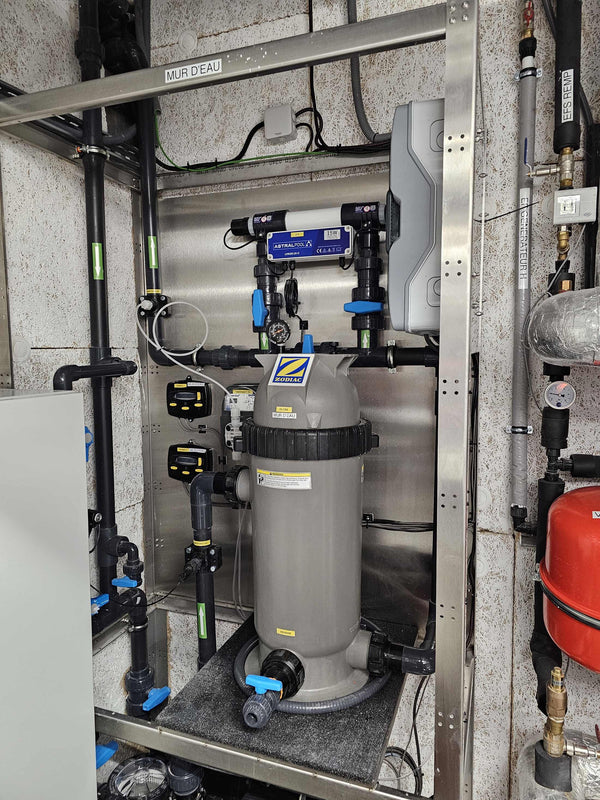
Stainless steel pool water treatment and filtration
"In this article, I will explain everything you need to know about water treatment and filtration for stainless steel pools and spas: processes, products, standards, and best practices to ensure pure water and preserve the durability of installations. We will also address the specifics of public establishments (ERP), with a focus on regulatory and technical requirements. Finally, we will explore the particularities of water treatment for water walls, decorative elements requiring special attention to maintain their aesthetics and functionality."

Romain Wanecque
Romain WANECQUE is the founder of STEEL AND STYLE. A graduate of a Master's degree from the Polytechnic University of Montpellier, he also holds an IWT (International Welding Technician) and an IWE (International Welding Engineer).

Water Treatment for Stainless Steel Pools
Water in stainless steel pools requires appropriate treatment to ensure the durability of the basin while maintaining healthy and crystal-clear water. Two main treatment solutions are recommended to preserve the integrity of stainless surfaces: liquid chlorine disinfection and active oxygen disinfection coupled with UV treatment. Each of these solutions offers specific advantages in terms of effectiveness, maintenance, and operating costs.
Stainless steel is an ideal material for swimming pools due to its smooth, non-porous surface, which prevents algae and microorganisms from adhering. This property significantly reduces the need for chemicals and manual maintenance, while ensuring better hygiene and healthier water for bathers.
1. Key Concepts of Disinfection and Water Treatment in Pools
Swimming pool water treatment relies on several essential concepts to ensure optimal water quality, both for bathers' comfort and the longevity of the installations. This article explores the concepts of disinfection, residual and non-residual products, turbidity, disinfected versus disinfecting water, as well as the different chlorine derivatives and their elimination.
1. Water Disinfection: What is it?
Disinfection aims to eliminate or inactivate pathogenic microorganisms (bacteria, viruses, algae) to prevent health risks. The most commonly used disinfectants are:
Chlorine (liquid, gas, granular, tablets).
Active oxygen.
Bromine.
Ozone and UV systems.
Each method has advantages and disadvantages depending on operating conditions and the type of pool.
2. Residual and Non-Residual Products
Disinfectant products can be classified into two categories:
-
Residual products: These remain present in the water for an extended period and continue to act against contaminants. Examples: chlorine, bromine.
Advantages: Continuous protection, long-lasting effect.
Disadvantages: Risk of overdose, production of potentially harmful by-products.
-
Non-residual products: Their effect is immediate but does not persist over time, such as ozone and active oxygen.
Advantages: No residues, respectful of stainless steel materials.
Disadvantages: Requires continuous application or combination with other systems.
3. Disinfected Water vs. Disinfecting Water
It is crucial to distinguish between these two concepts:
Disinfected water: The water has been treated to eliminate microorganisms present at the time of analysis.
Disinfecting water: The water contains a sufficient concentration of active disinfectant capable of eliminating any new contamination in real-time.
The goal of good treatment is to have disinfecting water continuously.
4. Water Turbidity
Turbidity measures the clarity of water, influenced by the presence of suspended particles. Cloudy water is not only aesthetically unpleasant but also impairs the effectiveness of disinfectants.
Factors influencing turbidity:
Finishing of filtration (sand, cartridge, diatomaceous earth).
Organic load (bathers, external pollution).
Inappropriate chemical dosing.
High turbidity levels can hide pathogens and reduce treatment effectiveness.
5. The Different Chlorine Derivatives and Their Elimination
Commonly used chlorine derivatives are:
Free chlorine (sodium hypochlorite, calcium hypochlorite): effective for killing microorganisms.
Combined chlorine (chloramines): results from the reaction of chlorine with organic matter, responsible for irritation and odors.
Total chlorine: sum of free and combined chlorine.
Methods for eliminating chlorinated by-products:
Dechloramination: Use of techniques such as aeration, UV, or excess hypochlorite injection to break down chloramines.
Dechlorination: Use of chemical reducers (sodium bisulfite, activated carbon) to eliminate excess chlorine before discharge.
2. Hydraulics
Pool hydraulics refer to the way water circulates through the basin, directly influencing its homogeneity, filtration quality, and the effectiveness of chemical treatments. A good choice of hydraulic system optimizes water clarity, limits dead zones, and reduces chemical consumption.
1. Traditional Hydraulics (Lateral Return and Skimmers)
This system is based on water returning from the pool walls, with suction through skimmers located on the surface.
Advantages:
Relatively low installation cost.
Easy to set up, ideal for private pools.
Simple maintenance with easy access to skimmers.
Disadvantages:
Less homogeneous water circulation.
Potential dead zones where impurities can accumulate.
Less suitable for large pools.
2. Inverted Hydraulics (Bottom Return and Skimmer Suction)
Water is returned from the bottom of the pool and drawn through surface skimmers, ensuring more uniform circulation.
Advantages:
Better water homogenization.
Reduction of dead zones.
Improved chemical dispersion.
Disadvantages:
Higher installation cost.
Complexity of implementation.
More demanding maintenance.
3. Mixed Hydraulics (Lateral and Bottom Return, Skimmer and Bottom Drain Suction)
This system combines returns from the walls and bottom of the pool, allowing for optimal water circulation.
Advantages:
Efficient circulation throughout the pool.
Optimization of filtration and chemical treatments.
Ideal for communal pools.
Disadvantages:
Higher installation and operating costs.
Requires precise design to avoid hydraulic short circuits.
4. Overflow (Perimeter or Partial)
Water flows over the edges of the pool into a balance tank, before being filtered and returned to the pool from the bottom or walls.
Advantages:
Excellent water homogenization.
Effective removal of floating impurities.
High-end aesthetic effect.
Disadvantages:
Expensive installation.
Requires regular maintenance of the balance tank.
-
More bulk in the technical rooms.
5. Turbo Hydraulics (Jet Systems and Counter-Current Swimming)
These systems use powerful pumps to generate dynamic water flows, often for counter-current swimming.
Advantages:
Ideal for sports training and fitness.
Improved local water circulation.
Compact and adaptable.
Disadvantages:
Does not cover the entire volume of the basin.
Can lead to faster wear of equipment.
The choice of hydraulic type is essential to guarantee water quality and meet the specific needs of the project. Good circulation optimizes water treatment, minimizes chemical consumption, and improves the bather experience. Steel and Style supports you in the design and installation of the hydraulic system best suited to your needs.
3. Analysis & Regulation
Pool water analysis and regulation are essential to ensure optimal water quality, meeting health standards and bather comfort. A good monitoring system relies on precise measurements and effective regulation of residual chemicals in the water, such as chlorine and pH.
Injection and regulation are two essential concepts in pool water treatment. Injection simply consists of introducing a chemical product (chlorine, pH-) into the basin, without considering the actual water levels. In contrast, regulation involves a closed-loop control where a probe continuously measures water parameters (pH, free chlorine, redox) and automatically adjusts the injection to maintain optimal values.
Types of Analysis and Measurement
Different methods allow for the analysis of pool water quality, depending on the probes and parameters measured:
-
Amperometric measurement:
This method is based on measuring the electric current produced by the chemical reaction of chlorine with water.
Advantages: high precision, real-time measurement.
Disadvantages: requires regular calibration and increased maintenance.
-
Free chlorine measurement:
Uses specialized probes that detect active chlorine present in the water.
Allows chlorine dosage to be adjusted according to the pool's needs.
-
Combined chlorine measurement:
Indicates the presence of chloramines, responsible for odors and irritation.
Essential for avoiding overdosing and optimizing water balance.
-
pH measurement:
A key element to ensure the effectiveness of disinfectants and preserve installations.
Analysis Chambers
Analysis chambers are essential devices for sampling pool water and subjecting it to various measurement probes. They ensure a constant flow of water in a controlled environment, guaranteeing precise and reliable measurements.
Characteristics of analysis chambers:
They ensure a constant water flow, allowing stable measurements.
Integration of filters to prevent probe fouling.
Compatibility with different types of sensors for comprehensive monitoring.
Types of Regulation
To maintain the chemical balance of the water, different regulation strategies can be implemented:
-
Proportional regulation:
Injects the chemical product based on the deviation measured from the target value.
Advantage: reduced risk of overdosing and optimized product consumption.
-
Hysteresis regulation:
Uses a tolerance range around the setpoint value to avoid overly frequent on/off cycles.
Advantage: increased equipment lifespan and reduced sudden variations.
Chemical Product Injection Equipment
The injection of chemical products is a crucial aspect of water treatment. Different types of equipment are used to ensure efficient and precise distribution:
-
Peristaltic pumps:
Operate by compressing a flexible tube to precisely inject the required amount of product.
Advantages: high dosing accuracy, easy maintenance, quiet operation.
Disadvantages: tube wear requiring periodic replacement.
-
Electromagnetic Injectors:
Operate via a pulsating diaphragm to dispense products.
Advantages: resistance to aggressive chemicals, suitable for large volumes.
The combination of these systems with sensors and automated regulators ensures optimized water treatment, reducing product consumption and preserving the quality of stainless steel installations.
4. Water Treatment with Liquid Chlorine and Automated Regulation
Liquid chlorine treatment is a classic and reliable method widely adopted in public and private swimming pools. Chlorine acts as a powerful oxidant, effectively eliminating bacteria, viruses, and other organic contaminants.
Advantages:
Optimal disinfecting efficacy: Chlorine ensures rapid and continuous disinfection.
Compatibility with automatic regulation systems: Devices such as those from Bayrol, Lavito, or Syclope allow for precise dosing and real-time control of pH and chlorine levels.
Moderate cost: Liquid chlorine is economical compared to other solutions.
Disadvantages:
Frequent maintenance: Storage and handling of chlorine require precautions.
Risk of corrosion if improperly dosed: Excess chlorine or poorly regulated pH can damage stainless steel.
5. Water Treatment with Active Oxygen and UV
This solution combines the action of active oxygen, a powerful oxidizing agent, with a ultraviolet (UV) disinfection system. Active oxygen attacks organic contaminants while UV neutralizes microorganisms, providing pure water without residual chlorine.
Advantages:
No odor or irritation: Ideal for people sensitive to chlorine.
Stainless steel friendly: Less aggressive than chlorine, this treatment preserves the passive layer of the steel.
Ecological treatment: Active oxygen leaves no harmful by-products.
Disadvantages:
Higher initial cost: The installation of a UV and active oxygen injection system represents a significant investment.
Limited effectiveness with high attendance: May require occasional chlorine supplementation.
6. Water Treatment with Ozonator
Ozonators provide an advanced water treatment solution by generating ozone (O₃), a powerful oxidant capable of rapidly eliminating microorganisms, organic contaminants, and chloramines.
Advantages:
Superior efficiency: Ozone is a more powerful disinfectant than chlorine, destroying viruses and bacteria in record time.
Environmentally friendly: Ozone decomposes into oxygen, leaving no chemical residue in the water.
Reduced chemical use: Decreases chlorine or active oxygen consumption.
Disadvantages:
High initial cost: Ozonation equipment requires a significant investment.
Specific maintenance: Requires regular maintenance of ozone generators.


7. Daily Chemical Products
Chemicals used in swimming pools can be residual or non-residual depending on their function:
pH- and pH+: Used to adjust the acid-base balance of the water, directly affecting the effectiveness of disinfectants and swimmer comfort.
Chlorine: Residual disinfectant ensuring continuous action against microorganisms.
Active oxygen: Non-residual product, offering rapid action without the formation of harmful residues.
Algicide: Prevents algae proliferation and ensures water transparency.
Flocculant and clarifier: Improve filtration by agglomerating fine particles, thus reducing turbidity.
Metal sequestrant: Prevents the precipitation of metallic ions, limiting stains and deposits in the pool.


8. Pool Water Filtration
Choosing the right filtration system is essential to ensure water quality and reduce turbidity. The main types of filters are:
Sand filters: Good compromise between cost and efficiency, with a filtration fineness of 30 to 50 microns.
AFM glass filters: More advanced technology offering finer filtration (10-15 microns) and a longer lifespan.
Cartridge filters: Ideal for small pools, ensuring fine filtration (10 microns), but requiring frequent cleaning.
Pump pre-filters play a crucial role in capturing large impurities before they reach the main filtration system, thus preserving the lifespan of the equipment.
Cleaning robots equipped with integrated filtration systems can capture fine particles directly in the pool, effectively complementing the main system.
Filter Maintenance:
Backwashing: Periodic cleaning of sand/glass filters to remove accumulated impurities.
Changing filter media: AFM glass has a longer lifespan than sand and requires less frequent replacement.
Cartridge cleaning: Frequent rinsing and replacement in case of wear.
Regular maintenance ensures optimal water quality and extends the lifespan of the installations.
Filtration Speed:
The water circulation speed in a filter plays a crucial role in pool water quality. An unsuitable flow rate can compromise filtration efficiency and lead to various problems related to water clarity and hygiene.
Impact of excessively high speed:
- Reduced filtration efficiency: When water circulates too quickly through the filter, fine particles do not have enough time to be captured by the filter media (sand, AFM glass, cartridge), which reduces retention capacity and results in cloudier water.
- Increased system pressure: An excessively high flow rate can cause a pressure increase, leading to premature wear of equipment (pumps, filters, valves) and increased energy consumption.
- Filter media erosion: Too fast a flow can displace sand or glass grains, creating preferential channels that reduce filtration efficiency.
- Risk of fine particle entrainment: Impurities can be resuspended and returned to the pool instead of being captured by the filter.
Impact of excessively low speed:
- Accumulation of contaminants: If water circulates too slowly, suspended particles can accumulate in the pool rather than being effectively aspirated and filtered.
- Risk of filter clogging: Too low a flow rate leads to excessive retention of impurities, increasing filter media clogging and reducing circulation capacity.
- Poor chemical distribution: Inefficient filtration prevents homogeneous diffusion of disinfectants in the pool, promoting the proliferation of algae and bacteria.
- Biofilm formation: Insufficient circulation can lead to stagnant areas in the filter, promoting the development of biofilms and undesirable microorganisms.
Optimization of circulation speed:
To ensure optimal filtration, it is recommended to adhere to the recommended circulation speeds according to the type of filter:
- Sand/glass filters: 30 to 50 m³/h/m² of filter surface area.
- Cartridge filters: 5 to 10 m³/h/m², requiring a lower flow rate to avoid rapid saturation.
- Diatomaceous earth filters: 1 to 5 m³/h/m², offering fine filtration but requiring a low flow rate.
A well-adjusted circulation speed optimizes filtration fineness, ensures good water quality while extending equipment lifespan and reducing energy consumption.

9. Periodic Maintenance of Stainless Steel Pools: Best Practices and Tips
Regular maintenance is essential to preserve water quality and ensure the longevity of stainless steel pool equipment. Periodic monitoring must include precise control measures, the use of suitable products, and the replacement of wear parts to guarantee optimal operation and healthy water.
Regular Control Measures
To maintain a stable chemical balance, it is recommended to frequently analyze the following parameters:
- pH (ideally between 7.2 and 7.6) to optimize disinfectant effectiveness.
- Total Alkalinity (TAC) to stabilize pH and prevent fluctuations.
- Total Hardness (TH) to prevent scale deposits on stainless steel surfaces.
- Free and combined chlorine to ensure disinfectant water while avoiding the formation of harmful chloramines.
- Turbidity to ensure optimal water clarity and prevent filter clogging.
Use of Treatment Products
The use of disinfection products suitable for stainless steel pools is essential to prevent corrosion and preserve the protective passive layer. Recommended products include:
- Shock chlorine (calcium or sodium hypochlorite): used occasionally in case of heavy water contamination (after intensive use or chemical imbalance).
- Slow-release chlorine (tablets or liquid): ensures continuous disinfection with regular diffusion, to be used in conjunction with a pH regulator to avoid overdosing.
- Specific stainless steel maintenance products: such as metal sequestrants to prevent stains or the precipitation of mineral deposits.
Replacement of Wear Parts
Certain equipment requires periodic replacement to maintain performance:
- UV lamps: Their effectiveness decreases after approximately 8,000 hours of use; regular replacement is necessary to ensure good complementary disinfection.
- Regulation probes (pH, Redox, chlorine): Must be calibrated regularly and replaced according to manufacturer recommendations to ensure accurate measurements.
- Peristaltic pumps and injectors: Check tubes and membranes to prevent leaks or performance degradation.
Calibration and Verification of Equipment
To ensure optimal chemical regulation, it is essential to regularly calibrate the measuring probes and check the proper functioning of automatic regulators. The use of specific buffer solutions is recommended for reliable equipment calibration.
In conclusion, a structured maintenance program including regular checks, rigorous management of chemicals, and preventive replacement of key components ensures the longevity of stainless steel pools and contributes to impeccably high-quality bathing water.
TOPO FLASH: The Taylor Balance, Principle and Benefits
The Taylor Balance is an essential tool used in chemical water balancing, particularly for swimming pools and spas. Its objective is to determine the water's calcium-carbonic balance, which helps prevent two main problems:
Scaling (limescale deposits)
Corrosion (metal attack)
This balance relies on calculating the Langelier Saturation Index (LSI), or Taylor Index, to determine if the water is balanced.
Key Parameters of the Taylor Balance:
The Taylor balance takes into account 5 major parameters:
pH
Recommended value: 7.2 to 7.6 (ideal 7.4)
pH determines the acidity or alkalinity of the water. Too low a value is corrosive, while too high a value promotes scale.Water temperature
Typical value: around 28 to 34 °C (depending on use)
High temperature promotes limescale precipitation.Total Alkalinity (TA)
Recommended value: 80 to 120 mg/L (ppm)
It stabilizes the pH. Too low TA makes the pH unstable, too high TA promotes scaling.Calcium Hardness (CH)
Recommended value: 150 to 250 mg/L (ppm)
Low hardness leads to potential equipment corrosion. Too high, it causes limescale deposits.Total Dissolved Solids (TDS) concentration
It has a minor influence on the balance but should remain reasonable (<1000 mg/L ideally).
Calculation of the Taylor Index (Langelier Saturation Index):
The Taylor Index (LSI) is calculated as follows:
ISL=pH+F(T)+F(TAC)+F(TH)−12,1 \text{ISL} = pH + F(T) + F(TAC) + F(TH) - 12,1ISL=pH+F(T)+F(TAC)+F(TH)−12,1
F(T), F(TAC) and F(TH) are factors extracted from tables according to water temperature, alkalinity, and hardness.
Interpretation of the result:
LSI = 0: perfectly balanced water (ideal)
Positive LSI (>0.3): scaling tendency (risk of limescale)
Negative LSI (<-0.3): corrosive tendency (risk of corrosion)
Practical application:
Regularly measure the 5 key parameters (pH, temperature, TA, CH, TDS).
Calculate the LSI using specific tables or applications (often available from maintenance product suppliers).
-
Adjust the water according to the result obtained:
If LSI > 0.3: lower pH, adjust TA or CH.
If LSI < -0.3: increase pH, increase TA or CH.
Conclusion:
Regularly using the Taylor balance ensures healthy and perfectly balanced water. This protects your equipment (pumps, heaters, stainless steel, etc.) and improves bathers' comfort.

10. ARS Standards and Requirements for Treatment Systems in Public Access Buildings (ERP)
Stainless steel pools intended for Public Access Buildings (ERP) must meet strict standards imposed by the Regional Health Agency (ARS) to ensure the sanitary safety of users and compliance with hygiene criteria. These requirements cover several aspects of water treatment, from filtration to disinfection, including continuous water quality control.
1. ARS Required Water Quality Parameters
The ARS imposes strict thresholds for ERP pools to prevent any health risks:
- pH: Must be maintained between 6.9 and 7.7 to ensure the effectiveness of disinfectants and the comfort of swimmers.
- Residual free chlorine: Between 0.4 and 1.4 mg/L depending on the type of pool and its frequency of use.
- Combined chlorine (chloramines): Less than 0.6 mg/L to avoid irritation and limit odors.
- Turbidity: Must be less than 0.5 NFU (nephelometric turbidity units), ensuring perfectly clear water.
- Renewal rate: Daily water renewal must be planned, generally 30 liters per swimmer per day for collective pools.
2. Specific Treatment Requirements
To meet regulatory requirements, installations must be equipped with efficient treatment systems that comply with the following recommendations:
-
Automated disinfection systems:
- The use of an automatic disinfectant regulator (liquid chlorine or active oxygen type) is mandatory, with continuous measurement devices and data recording.
- Complementary UV systems reduce chloramines, thus optimizing air and water quality.
-
High-performance filtration:
- Filters must guarantee maximum filtration fineness (less than 15 microns for ERP pools).
- The water circulation speed in the filters must not exceed 30 m³/h/m² to maximize particle retention.
-
Optimized hydraulic circulation:
- The choice of appropriate hydraulics (overflow, skimmers, bottom return) must ensure homogeneous distribution of treatment products and complete pool coverage.
-
Equipment safety:
- Disinfectant level and pH alarms are mandatory to prevent critical thresholds from being exceeded.
- Chemical containment systems must be in place to ensure the safety of staff and users.
3. Regulatory Monitoring and Control
ERP pool installations are subject to regular sanitary control by the ARS, which carries out unannounced analyses and imposes strict monitoring obligations:
- Daily monitoring log: Pool managers must record water parameter readings (pH, chlorine, temperature, turbidity).
- Periodic bacteriological analyses: Detection of legionella, coliforms, and other pathogenic microorganisms.
- Equipment maintenance: Filters, pumps, and treatment devices must be maintained and checked according to a precise schedule to ensure their conformity.
11. Water Treatment for a Water Wall: Quality, Stability, and Deconcentration
The water used in a decorative or architectural water wall must be perfectly treated to ensure the durability of the installation, preserve the aesthetic appearance of the surfaces, and guarantee silent and fluid operation. Unlike a swimming pool or spa, the water in a water wall circulates in a closed loop, often continuously over visible materials (stainless steel, glass, stone, etc.), making the treatment particularly demanding. It is imperative to maintain low-mineralized water that is chemically stable to prevent scale deposits, corrosion, or whitish films. Here, the principle of deconcentration is applied, meaning a deliberate reduction in the concentration of mineral salts and dissolved solids. This "deconcentrated" water, often obtained from a reverse osmosis unit or a softening treatment followed by refining, helps limit saturation and prevents the appearance of traces or crystallization on surfaces. It is also recommended to regularly check the pH (ideally around 6.8 to 7.2), use a mild biocide (such as peroxide or UV) to prevent the proliferation of algae or biofilm, and partially renew the water in case of evaporation to preserve the overall quality of the circuit.
STEEL AND STYLE: Precision Engineering for Water Quality
STEEL AND STYLE offers its comprehensive expertise in the management of water treatment for stainless steel pools, combining advanced engineering, rigorous equipment selection, and tailored maintenance protocols. Thanks to our custom solutions and mastery of processes, we guarantee optimal water quality, meeting the most demanding standards for private pools and public access establishments.


