
Stainless Steel Metallurgy for Pool Applications
"In this article, I will explain everything you need to know about stainless steel, an essential material for modern swimming pools. You will discover what stainless steel really is, its different categories, and why certain grades such as 316L or Duplex are particularly suitable for the demanding environments of aquatic basins. I will also guide you through the essential processes to guarantee the longevity of your installations: from welding techniques to the indispensable pickling and passivation steps, as well as finishing choices like Scotch Brite or Poligrain 600. We will also address practical points, such as cleaning limescale deposits, good maintenance practices, and the importance of effective grounding to preserve the integrity of stainless steel pools. Finally, I will warn you against the risks of salt electrolysis systems, proposing suitable alternative solutions. This article is aimed at both engineers and aquatic design enthusiasts, and will allow you to better understand the technical subtleties of this exceptional material."

Romain Wanecque
Romain WANECQUE is the founder of STEEL AND STYLE. A graduate with a master's degree from the Polytechnic University of Montpellier, he also holds an IWT (International Welding Technologist) and an IWE (International Welding Engineer).

1. What is stainless steel?
Stainless steel, or "inox", is a steel alloy with high corrosion resistance. Its composition includes a minimum of 10.5% chromium, forming a passive layer of chromium oxide that protects the metal from oxidation and chemical attack. This layer is self-repairing and gives stainless steel its exceptional longevity.
2. Different types of stainless steel
Stainless steels are classified according to their crystalline structure, dictated by their chemical composition:
Austenitic:
- Common grades: 304L/1.4307 (A2 Stainless - Food grade), 316L/1.4404 (A4 Stainless - Marine grade).
- High corrosion resistance and excellent weldability.
- Applications: Pool walls, submerged equipment.
Austeno-ferritic:
- Common Grades: 1.4462 (Duplex), Uranus 65 (Super Duplex).
- Alloy combining mechanical strength and excellent resistance to chlorides.
- Applications: Thermal pools, saltwater pools.
Ferritic and Martensitic:
- Suitable for non-corrosive environments or those requiring high mechanical strength, but rarely used in swimming pools.
3. Stainless steel in swimming pools: suitable grades
In a swimming pool, continuous exposure to chemical agents (chlorides, disinfectants) requires a meticulous choice of stainless steel grade.
Recommended grades:
- 316L: Suitable for traditional chlorinated pools.
- Duplex 1.4462: Recommended for pools with high salinity or high temperature.
- Uranus 65: Essential for spas or thermal water pools.
Advantages:
- Corrosion resistance: Chloride ions do not alter the passive layer under normal operating conditions.
- Longevity: Reduced need for intensive maintenance thanks to durable materials.
- Aesthetics: Stainless brilliance that enhances installations.
4. Price of Stainless Steels (2025 Index)
The choice of stainless steel also depends on its cost per kilogram, influenced by its composition and availability:
- 304L (A2, food grade): Approximately €3.50 to €4.50/kg.
- 316L (A4, marine grade): Between €4.50 and €6/kg.
- Duplex (1.4462): Between €6 and €8/kg, depending on the supplier.
- Super Duplex / Uranus 65: Above €8/kg, due to its enhanced properties.


5. Corrosion resistance: chromium oxide and types of corrosion
Chromium oxide, formed by the chromium in stainless steel, acts as a natural protective barrier. However, certain environments can cause specific types of corrosion:
Common types of corrosion:
- Pitting: Caused by chloride ions. Prevent with molybdenum-rich grades like 316L or Duplex.
- Stress corrosion cracking: Fractures due to mechanical stresses combined with a chlorinated environment.
- Intergranular: Occurs after welding if the material is not properly pickled and passivated.
Importance of RA (Surface Roughness):
Low surface roughness (≤ 0.8 µm) limits chloride accumulation and promotes durability. Polished finishes (e.g., Poligrain 600, Scotch Brite...) are essential for submerged areas.
High RA (>0.8 µm) promotes the formation of micro-pockets where chloride ions can accumulate, leading to pitting corrosion.
Finishes: Scotch Brite and Poligrain 600:
Mechanical finishes play a crucial role in the resistance and aesthetics of stainless steels in swimming pools. Finishing processes aim to reduce surface roughness (RA, expressed in micrometers), which limits contaminant retention and optimizes passive protection.
- Scotch Brite: This satin finish uses non-woven abrasives to achieve a roughness of around 0.8 µm. Ideal for visible surfaces in standard environments, it offers a good balance between aesthetics and corrosion resistance.
- Poligrain 600: This finish is achieved with ultra-fine grains to reach a roughness of 0.4 µm or less, suitable for particularly corrosive environments (spas, saltwater pools). By minimizing microscopic peaks, this finish limits passive layer breakdown and reduces chloride adhesion.


6. Welding stainless steel for pool use
The stainless steel welding processes used in pools must guarantee the preservation of anticorrosion properties while avoiding structural defects.
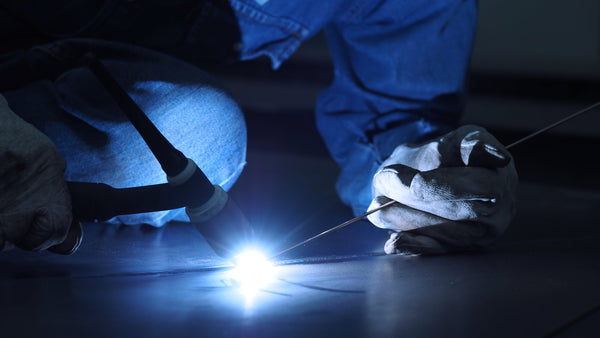
- TIG (Tungsten Inert Gas): A classic method for welding stainless steel, it uses an electric arc protected by an inert gas (argon or helium). This process limits impurities and allows for precise and homogeneous welding.
- Laser welding: Advanced technology offering high precision and a very small Heat Affected Zone (HAZ). Ideal for parts requiring long-term resistance, it minimizes dilution and preserves the integrity of the passive layer.
Importance of HAZ and dilution:
The HAZ is the zone where the properties of stainless steel can be altered by heat. An uncontrolled HAZ can lead to degradation of the passive layer, increasing the risk of corrosion. Dilution (mixture between base metal and filler metal) must be optimized to avoid the formation of chromium-depleted zones, responsible for intergranular corrosion. The choice of filler metal based on the base metal is therefore crucial for the quality of the final weld.
Piping inerting:
Piping inerting is an essential technique when welding stainless steel, especially for sensitive applications such as swimming pools. This method consists of replacing the air inside the piping with an inert gas, generally argon or helium, to protect the internal face of the weld against oxidation. Indeed, during the welding process, high temperatures can lead to the formation of oxides or discoloration inside the piping if it is not inerted. These defects can compromise the corrosion resistance and durability of the installation.

7. Pickling and passivation: essential steps
After welding or mechanical finishing, pickling and passivation are essential to restore the anticorrosion properties of stainless steel.
-
Chemical pickling: This process removes oxides, impurities and scale resulting from welding or manufacturing.
- Acids used:
- Mixture of nitric acid (HNO₃) and hydrofluoric acid (HF).
- Examples of products: Surfox (Walter), Pickling Paste (Avesta Finishing Chemicals).
- Suppliers: DBP Inox, Avesta, Henkel.
- Acids used:
-
Passivation: Once the surface is pickled, passivation regenerates the chromium oxide layer, which is essential for protecting stainless steel.
- Acid used: nitric acid or citric acid, which promote the formation of the passive layer without toxic residues.
- Suppliers: CitriSurf (Stellar Solutions), Avesta.
These steps are crucial to avoid the risk of corrosion, especially in chlorinated environments.

8. Maintenance of stainless steel over time
Well-maintained stainless steel retains its anti-corrosion properties and aesthetic appeal, even in aggressive environments like swimming pools.
Best practices:
- Regular cleaning: Use mild solutions based on water and non-chlorinated detergents. Avoid abrasive products and sodium hypochlorite (bleach) based cleaners.
- Systematic rinsing: After exposure to disinfectants or chlorinated water, rinse surfaces with clear water to remove chloride residues.
- Periodic inspection: Regularly check the condition of welds, finishes and the passive layer to detect early signs of corrosion.
Recommended products:
- Maintenance passivators: CitriSurf 77 Plus.
- Specialized detergents: Inox Clean Gel (Bohle), Innosoft B570.
Cleaning limescale deposits: essential maintenance:
In regions with hard water, the accumulation of limescale deposits can alter the performance and aesthetics of stainless steel surfaces.
Cleaning procedure:
- Use mild acidic solutions such as citric acid, household vinegar or dedicated cleaners (e.g., Innosoft B570).
- Apply with a non-abrasive sponge to preserve the finish.
- Rinse thoroughly with clean water to avoid chemical residues.
Tip: Avoid chlorinated or abrasive products, which could damage the passive layer.
9. Guide to good practices
To ensure optimal durability, the following steps must be respected at each phase of the project:
Design and manufacturing:
- Prefer simple geometries and inclined surfaces to limit water retention zones.
- Use continuous welds to avoid weld repairs.
- Limit unventilated areas (e.g., overflow channels).
- For indoor installations, the dehumidification system must be perfectly sized to avoid excessively high chloramine levels.
Choice of materials:
- For standard pools: 316L (A4, marine grade).
- For spas and saline environments: Duplex or Super Duplex (1.4462, Uranus 65).
- Use sheets protected by a laser film.
Installation:
- Opt for compatible support materials to avoid galvanic corrosion.
- Check that lifting and handling equipment (cranes, hoists) is suitable to avoid deformation.
- Before the first filling, pickle and passivate the entire pool.
- Avoid any contact with ferrous elements. Protect the pool.
Maintenance:
- Schedule quarterly cleaning with appropriate products.
- Inspect and renew passivation every 2 to 3 years depending on the environment.
The Crucial Importance of Grounding Stainless Steel Pools:
Grounding stainless steel pools is an essential step to ensure the safety of installations and preserve the integrity of the material. A stainless steel pool, as an electrical conductor, can be subject to electrochemical and electrostatic phenomena if it is not properly connected to a non-electrical ground.
Why is grounding essential?
-
Avoid galvanic corrosion:
Without grounding, stray currents (induced by nearby electrical equipment or potential differences in the ground) can flow through the stainless steel pool. This can lead to accelerated corrosion of the walls or welds, rapidly degrading the installation. -
Protect users:
Poor insulation or defects in the electrical circuit can create dangerous voltages for swimmers. Effective grounding allows these currents to dissipate and eliminates any risk of electric shock. -
Preserve the effectiveness of chemical treatments:
Electrostatic phenomena, common in the absence of grounding, can alter the effectiveness of water treatments (chlorine, active oxygen), modifying the chemical balances necessary for disinfection. -
Why favor a non-electrical ground?
A non-electrical ground, dedicated solely to the stainless steel pool, offers better dissipation of stray currents without interfering with other electrical systems in the building. This approach also reduces the risk of electrical overloads that could affect other equipment (pumps, lighting, automation).
-
Risks of absence of grounding:
- Accelerated corrosion: Rapid appearance of pitting and cracks on the stainless steel walls.
- Risk to users: Potential electric shocks in case of a defect in the electrical system.
- Equipment degradation: Stray currents can damage submerged metallic accessories, such as nozzles or lights.
Advice: To ensure a safe and durable installation, entrust the grounding of the pool to qualified professionals, using specific connectors suitable for stainless steel and complying with current standards (NF C15-100). Periodic checks are also recommended to ensure continuous protection.
Incompatibility of salt electrolysis treatments:
Pools using salt electrolysis systems present a high risk for stainless steel structures due to the significant concentration of chloride ions (greater than 4 g/L).
Induced problems:
- Accelerated pitting corrosion: The passive layer of stainless steel is attacked by chlorides.
- Formation of sodium hypochlorite: A highly corrosive product, generated by electrolysis, which deteriorates stainless steel surfaces.
Alternative solutions proposed by STEEL AND STYLE:
- Liquid chlorine disinfection (pH- regulation): Stable and compatible with stainless steel.
- Active oxygen coupled with UV treatment: Gentle method, ideal for preserving stainless steel finishes.
- These alternatives ensure healthy water while preserving the integrity of the structures.

10. Bibliography
Stainless steel in swimming pools: robustness, durability, and aesthetics:
Discover in this document a comprehensive analysis of the advantages of stainless steel for swimming pools: anti-corrosion properties, suitable grades (316L, Duplex), finishes, welding techniques, and maintenance. An essential reference for designing elegant and durable pools that meet the technical and economic requirements of modern projects.

Stainless Steels - Implementation:
This PDF addresses the different steps and techniques for implementing stainless steels, including cutting, machining, plastic deformation, deep drawing, welding, and finishing treatments such as pickling and passivation. It explores the nuances of stainless steels and their behavior, while providing technical recommendations to optimize their performance according to specific applications. An essential guide for professionals working with these materials.

Stainless Steels - Properties, Corrosion Resistance:
This document explores the properties and corrosion resistance of stainless steels. It analyzes passivity, types of corrosion, and suitable solutions for corrosive environments.

Guide to surface finishes:
This detailed guide to stainless steel finishes explores surface processes, from rolling to mechanical, electropolished, textured, and colored finishes, as well as their architectural applications.


